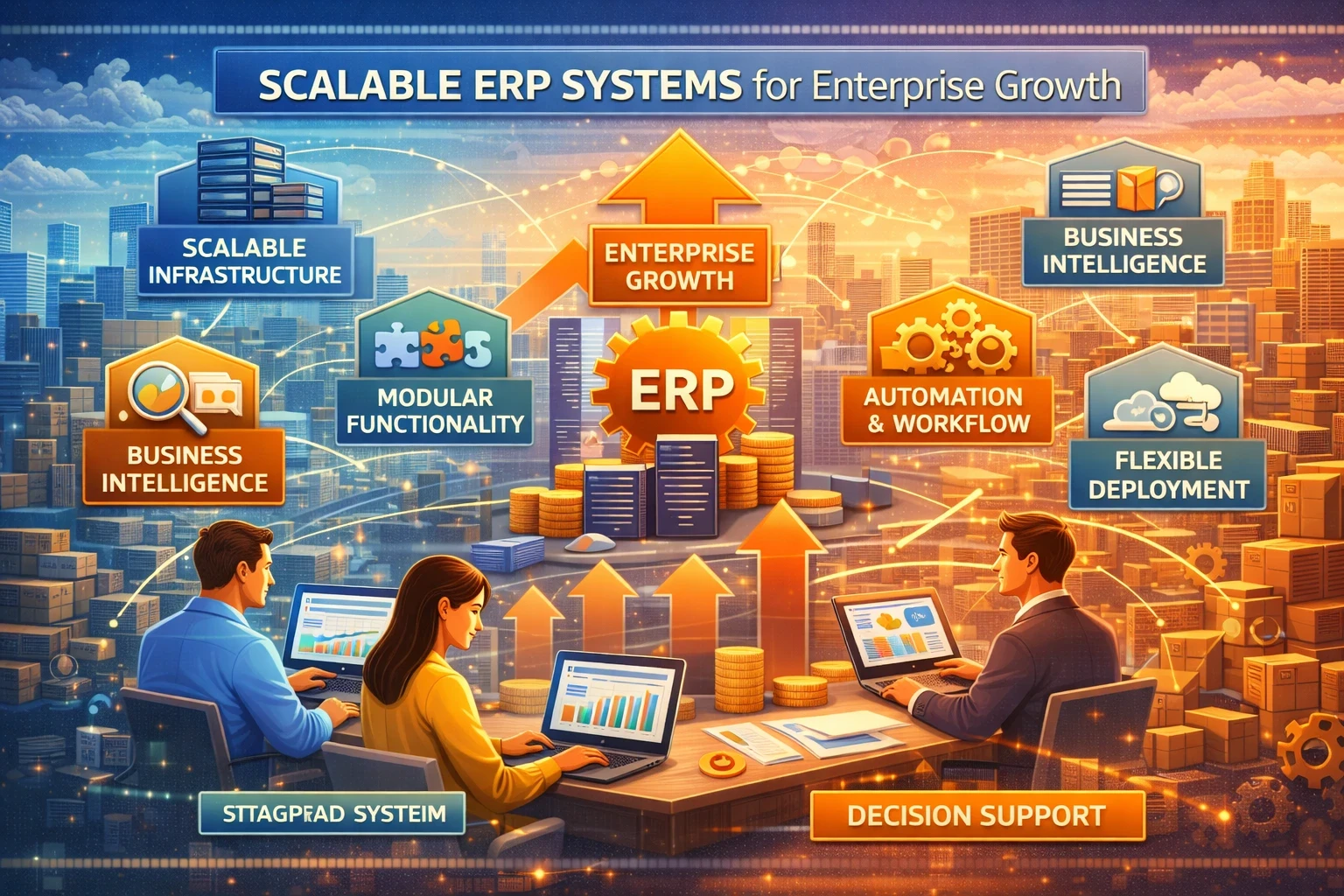
Enterprises rarely fail because they lack ambition. They struggle when growth exposes messy processes: new entities, new geographies, new product lines, new compliance rules, new warehouses, new revenue streams. A scalable ERP system keeps that growth from turning into daily fire drills. It gives you one data spine for finance, supply chain, inventory, procurement, projects, and reporting, while staying flexible enough to keep up with change.
If you are evaluating ERP systems for fast expansion, treat “scalability” as a set of business outcomes, not a vendor slogan. You want faster rollouts, cleaner integrations, reliable performance at higher transaction volumes, and governance that does not crumble when you add the next subsidiary.
Quick checklist to judge ERP scalability
☐ Supports multi-entity, multi-currency, multi-tax, multi-country setups
☐ Handles higher transaction volume without “reporting timeouts”
☐ Offers strong role-based access and audit trails for compliance
☐ Gives real-time visibility across finance and operations with one source of truth
☐ Integrates cleanly with CRM, WMS, HRMS, e-commerce, POS, and BI tools
☐ Lets you standardize core processes while allowing local variations
☐ Provides a predictable upgrade path (especially for cloud enterprise resource planning)
☐ Includes solid APIs and event-based integration options
☐ Has proven tools for data migration, sandbox testing, and rollout automation
☐ Comes with a realistic plan for change management and user adoption
These checks map directly to growth pain points: faster close, fewer stockouts, smoother audits, and a clearer view of cash and margin.
What “scalable ERP” really means
A scalable enterprise resource planning platform grows with you in four ways:
1) Organizational scale
You add legal entities, cost centers, business units, and subsidiaries. Your ERP must support consolidation, intercompany transactions, and consistent chart-of-accounts governance.
2) Operational scale
You add warehouses, suppliers, SKUs, production sites, service teams, and logistics lanes. You need stable inventory and order processing plus strong planning.
3) Geographic scale
You expand into new tax rules, invoicing norms, statutory reporting, data residency needs, and language requirements.
4) Integration scale
You stop working in one monolith. You add best-of-breed tools and industry apps. Your ERP must stay the system of record while connecting reliably.
Cloud-first systems often handle these scaling paths better, since they reduce infrastructure work and standardize upgrades. Microsoft’s cloud ERP overview highlights scalability and real-time access as core benefits of cloud ERP software.
Deployment choices that affect growth
Your deployment model shapes cost, speed, and flexibility. Use this table as a quick filter.
| Approach | Best for | What you gain | Watch-outs |
|---|---|---|---|
| Cloud ERP SaaS | Fast-growing companies that want faster innovation cycles | Quicker updates, less infrastructure burden, easier global access | Requires disciplined configuration and governance |
| Private cloud | Regulated industries needing more control | More customization control with cloud infrastructure benefits | Heavier management effort than SaaS |
| On-premise | Very specific legacy constraints | Full control of hosting and upgrades | Slower upgrades, higher infra burden, harder to scale teams |
| Hybrid | Mixed constraints across regions or business units | Flexible transition path | Integration and data governance must stay tight |
| Two-tier ERP | Global core with regional or subsidiary ERP | Faster subsidiary rollout, local fit | Risk of fragmented master data if governance slips |
Two-tier is common in multinationals: a global template for finance and standards, and a lighter local system for speed in smaller units. That model shows up frequently in enterprise rollout strategies.
Composable ERP and why it matters for scale
Many enterprises now treat ERP as a platform plus modular capabilities. Gartner describes composable ERP as an adaptive strategy that helps enterprises keep up with fast change by delivering foundational operational capabilities that can evolve over time.
For growth, this matters because expansion rarely follows one clean plan. You might acquire a company with different tooling, launch D2C, add subscription billing, or open new countries faster than expected. A composable mindset helps you avoid “rip and replace” projects every time your model shifts.
Practical signals that a vendor supports this:
-
Mature APIs and integration patterns
-
Modular licensing and clear add-on capabilities
-
Strong partner ecosystem
-
Good sandbox environments and testing automation
ERP capabilities that drive enterprise growth
Financial control that does not slow expansion
Growth creates complexity in revenue recognition, intercompany accounting, tax, and consolidation. Scalable ERP must support:
-
Multi-entity consolidations
-
Automated intercompany eliminations
-
Close automation and audit trails
-
Budgeting, forecasting, and variance reporting
Inventory and supply chain that stays reliable at higher volume
If you scale SKUs or warehouses, weak inventory logic becomes expensive fast. Look for:
-
Strong inventory valuation and traceability
-
Demand planning and replenishment tools
-
Warehouse and logistics integration options
-
Real-time visibility for stock and order status
This ties directly to high-intent needs like enterprise resource planning inventory management and manufacturing enterprise resource planning system.
Performance and analytics in one system of truth
You should not wait hours for basic margin or aging reports. Many modern cloud ERPs build around in-memory processing and embedded analytics. SAP’s S/4HANA Cloud Public Edition documentation describes the product as built on SAP HANA to support real-time processes and a single source of truth.
Security, roles, and compliance by design
Enterprises cannot scale access informally. You need:
-
Role-based access control aligned to job functions
-
Segregation of duties controls
-
Audit logs and approval workflows
-
Support for local statutory reporting
Vendor shortlisting that stays grounded
Avoid picking an ERP just because it is popular. Start with your growth pattern:
-
Rapid multi-country growth with standardized processes: systems like SAP S/4HANA Cloud and Microsoft Dynamics 365 often fit this path.
-
Fast rollout for multi-subsidiary operations: cloud enterprise resource planning with strong templates and repeatable deployment tooling helps.
-
Mid-market to enterprise moving fast with finance-first modernization: suites like NetSuite often emphasize readiness assessments and structured adoption planning.
When you shortlist, ask vendors to show these scenarios live:
-
Add a new legal entity and run intercompany posting
-
Run consolidation and produce statutory-ready reports
-
Process a high-volume batch of orders and show performance
-
Integrate one external system through APIs and show error handling
-
Run role-based access reviews and audit logs
Implementation plan that supports scale
A scalable ERP fails more often from rollout design than from features. Use a phased approach:
Step 1: ERP readiness and scope discipline
NetSuite’s ERP readiness guidance points to assessing financial, technical, and cultural capacity before committing to ERP change.
Treat readiness as a real gate. If master data is messy or process ownership is unclear, fix that before you migrate.
Step 2: Build a global template, then replicate
Create a core process template: chart of accounts, approval flows, core procure-to-pay, order-to-cash, inventory rules. Replicate that template per entity or region with controlled variations.
Step 3: Data governance that survives growth
If item masters, customer records, and vendor masters drift, scaling becomes painful. Assign owners, define naming conventions, and enforce validation.
Step 4: Integration and reporting as first-class work
Integrations break silently when teams rush. Define monitoring, retries, and audit trails from day one.
Step 5: Change management with measurable adoption
Track training completion, process compliance, error rates, and close cycle time. Tie adoption to leadership metrics.
Final take
A scalable ERP system supports enterprise growth when it handles new entities and regions smoothly, keeps data clean, integrates without chaos, and stays fast under load. Pick the model that matches your expansion pattern, validate scalability with real scenarios, and treat governance and adoption as core engineering work, not “training tasks.”